Analysis Build · electrical
Lithium-Ion vs. Lead-Acid Batteries: The Right Choice for Data Center
VRLA or lithium batteries for a data centre UPS? Fire risk, floor space, battery life and adoption compared using vendor, Eurobat and Uptime data.
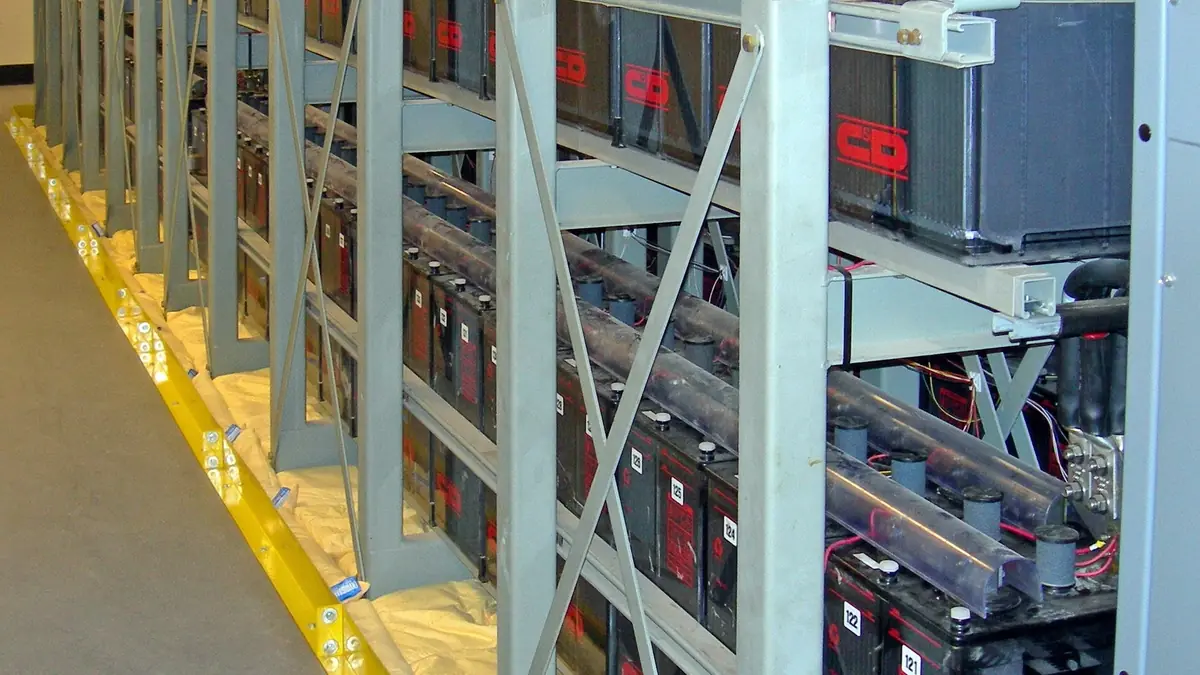
For a data centre UPS, lithium-ion batteries take less floor space, weigh less and keep their life in warm rooms, where valve-regulated lead-acid (VRLA) batteries age quickly. Against that, the Uptime Institute rates lithium-ion as the greater fire risk, and a lithium-ion installation brings fire testing, separation and suppression questions that the engineer has to settle with the authority and the insurer. Neither chemistry is the right choice everywhere. The decision turns on the room temperature you can hold, the floor area you have and the fire strategy the site will accept.
Key takeaways
- The Uptime Institute states that lithium-ion batteries present a greater fire risk than VRLA batteries whatever their chemistry, a position it says the US National Fire Protection Association endorses. A battery management system reduces that risk without removing it.
- In Schneider Electric’s comparison for a Galaxy VL 500 kVA UPS with 10 minutes of runtime, VRLA cabinets occupy 3.4 m² and lithium-ion cabinets 1.1 m², about two-thirds less floor area, with 60 to 70% less weight.
- Eurobat classes VRLA calendar life from 3 to 5 years up to more than 12 years, and float operation above 20 °C cuts life by 50% for every 10 °C of constant increase.
- Over a 15-year UPS life, a long-life VRLA battery held at 20 °C needs the same number of replacements as a lithium-ion battery at its 10-year warranty. A warm room or a shorter VRLA class gives lithium-ion one or two fewer changeouts.
- In Uptime’s 2021 survey nearly half of operators used lithium-ion in centralised UPS plants, up from about a quarter three years earlier. The share of UPS vendors reporting rising adoption for centralised UPS fell from 72% in 2022 to 63% in 2024.
Fire risk: where the two chemistries differ
VRLA batteries emit hydrogen, so Eurobat requires battery rooms and cabinets to be ventilated in line with national regulation or IEC/EN 62485-2. Eurobat also warns that temperatures above 40 °C can drive float current ever higher until the battery enters thermal runaway. In the OVHcloud SBG2 fire in Strasbourg, where the batteries were lead-acid, the French investigator BEA-RI found that fire broke out almost simultaneously in a battery room and in a UPS. It named the building design, the absence of automatic extinguishing, an inadequate water supply and the delay in cutting the power as factors in the spread, and noted that lead-acid is a more robust and stable technology than lithium.
Lithium-ion carries the larger risk. The Uptime Institute explains that cell breakdown releases combustible gases, including oxygen, and that a thermal runaway can spread between cells, across battery packs and potentially between cabinets that are placed too close together. It judges gaseous (clean agent) suppression effective at slowing the spread of a fire in the early stages of a cell failure when paired with early detection, but arguably less suitable for a major thermal runaway, where water and foam are likely to perform better because they cool. Chemistry matters within lithium-ion too. Uptime notes that lithium iron phosphate (LFP) has a higher ignition point and releases no oxygen as it decomposes. Vertiv’s HPL cabinet uses nickel manganese cobalt (NMC) cells, while the Schneider cabinet documents give a 3.8 V nominal cell voltage without naming the chemistry.
The SK C&C Pangyo fire, 2022
On 15 October 2022 a fire broke out in the battery room on the third basement floor of SK C&C’s Pangyo data centre in South Korea. KakaoTalk and other services were down for more than 11 hours, and the fire was fully extinguished at 11:45 p.m. that day, according to the Korea Herald’s report of the Ministry of Science and ICT investigation. Uptime reports that firefighters needed around eight hours to bring the blaze under control.
The ignition cause remains contested in the sources. Kakao said a burning lithium-ion battery made by an SK Group subsidiary started the fire, and SK Group denied that its battery management system had shown any trouble, as DCD reported. The ministry’s findings concern the recovery. It named the lack of physical separation between the lithium-ion batteries and the UPS as the main cause of the slow recovery, and said the batteries were resistant to gas fire extinguishers, so the fire kept heating the UPS. It called for batteries to be separated from other electrical equipment and for better detection and extinguishing facilities for lithium-ion.
Standards that apply
In the United States, NFPA 855 is the standard for installing stationary energy storage systems, and UL 9540A is the test method for thermal runaway fire propagation, run at cell, module, unit and installation level. Both Schneider’s and Vertiv’s lithium-ion cabinets are UL 9540A tested. In Europe, IEC/EN 62485-2 covers ventilation for lead-acid installations, IEC 62485-5:2020 sets safety requirements for installing, using, inspecting, maintaining and disposing of stationary lithium-ion batteries up to 1,500 V DC, and IEC 62619 is the lithium-ion safety standard listed on the Vertiv HPL. The fire strategy itself belongs to the fire engineer and the local authority.
Footprint and weight: a 500 kVA worked comparison
Schneider Electric’s lithium-ion brochure gives one like-for-like case: a Galaxy VL 500 kVA UPS with 10 minutes of runtime. The VRLA option uses classic battery cabinets with a footprint of 4000 × 845 mm, or 3.4 m². The lithium-ion option uses Galaxy lithium-ion cabinets with a footprint of 1950 × 587 mm, or 1.1 m². That frees about 2.2 m² of battery room floor, a reduction of about two-thirds. Schneider also states 60 to 70% less weight for the lithium-ion option.
The space released is in the battery or electrical room. Centralised UPS batteries do not sit in IT racks, so the saving does not add rack positions unless the building layout lets the room shrink. The figures are Schneider’s for one rating and one runtime.
Named UPS battery cabinets compared
The table lists published data for one VRLA and two lithium-ion cabinets. The runtimes differ and Schneider does not publish the energy of the VRLA cabinet in the documents reviewed, so the rows should not be read as a one-to-one energy comparison.
| Cabinet | Chemistry | Energy | Weight, loaded | H × W × D (mm) | Floor area | Wh/kg (cabinet) |
|---|---|---|---|---|---|---|
| Schneider Galaxy VS GVSMODBC9 | VRLA, 9 Ah modules | Not published | 1,338 kg (nine strings) | 1970 × 550 × 847 | 0.47 m² | Not published |
| Schneider Galaxy Li-ion LIBSESMG17IEC | Lithium-ion, chemistry not named | 34.7 kWh (17 × 2.04 kWh) | 490 kg | 1970 × 650 × 587 | 0.38 m² | about 71 |
| Vertiv HPL-6 | Lithium-ion NMC | 38.0 kWh | 585 kg | 2022 × 600 × 725 | 0.44 m² | about 65 |
These cabinet figures of about 65 to 71 Wh/kg include enclosure, busbars and electronics, so they sit well below the cell-level densities often quoted for lithium-ion. On recharge, Schneider claims two to three times faster rates than VRLA and specifies a default charge rate of 0.7 C with a maximum continuous rate of 1.0 C. Actual recharge time depends on the charger power available in the UPS, so no single figure in hours applies.
Battery life and temperature
The Eurobat guide on VRLA batteries sorts them into calendar life classes: 3 to 5 years (standard commercial), 6 to 9 years (general purpose), 10/12 years (long life) and more than 12 years (very long life). Operating on float above 20 °C reduces life expectancy by 50% for every 10 °C of constant increase. Eurobat distinguishes design life from service life, which it bases on field experience under optimal conditions and ties closely to working conditions, and advises a 125% ageing factor in the initial sizing if the battery must deliver its full duty to the end of its life.
Lithium-ion life figures come from vendors. Vertiv quotes 10 to 15 years for its HPL against 3 to 5 years for VRLA, with a 10-year warranty. Schneider claims two to three times the expected life of VRLA. Both are marketing claims, and the VRLA figure Vertiv uses matches only Eurobat’s shortest class.
Worked example: battery sets over 15 years
Assume a UPS horizon of 15 years, the lifespan of up to 15 years that Schneider gives for its Galaxy VXL with lithium-ion batteries. Sets bought equals 15 divided by battery life, rounded up. Mid-life replacements are one fewer. Lives are design values, and no prices are applied.
| Battery and assumption | Life used | Sets over 15 years | Mid-life replacements |
|---|---|---|---|
| VRLA, standard commercial class (Vertiv’s 3 to 5 years) | 5 years | 3 | 2 |
| VRLA, Eurobat 10-year long life at 20 °C | 10 years | 2 | 1 |
| Same 10-year VRLA at a constant 30 °C (Eurobat: 50% less) | 5 years | 3 | 2 |
| Lithium-ion, low end (Vertiv warranty) | 10 years | 2 | 1 |
| Lithium-ion, high end (Vertiv) | 15 years | 1 | 0 |
A long-life VRLA battery held at 20 °C ties with lithium-ion at its warranty life. A warm room or a standard commercial VRLA class gives lithium-ion one or two fewer changeouts, and each changeout avoided removes a maintenance window in which, as Schneider notes, downtime or load interruption is a risk. Eurobat notes that service life depends strongly on working conditions such as temperature, which strengthens the case for lithium-ion in warm or poorly controlled rooms.
Cooling and room temperature
Lithium-ion cabinets do not free the battery room from temperature control. Schneider recommends 18 to 28 °C for its Galaxy lithium-ion cabinet, and Vertiv specifies 22 to 30 °C for the HPL. The benefit is that, within those ranges, the vendors say lithium-ion keeps its rated life, without the halving of life that Eurobat describes for VRLA above 20 °C, so the room can run warmer than a VRLA room held at 20 °C to protect its batteries. A smaller room also has less volume to cool. How much this saves depends on how the room is cooled; our comparison of cold and hot aisle containment covers the IT side of that question.
How widely data centres use lithium-ion UPS batteries
Uptime’s Global Data Center Survey 2021 found that nearly half of operators had adopted lithium-ion for their centralised UPS plants, up from about a quarter three years earlier, and the 2022 survey found adoption rising further. Uptime also reports that some vendors ship more than half of their major three-phase UPS systems with lithium-ion strings.
The 2024 supplier survey asked vendors whether customer adoption of lithium-ion was increasing. For centralised UPS, 72% of vendors said yes in 2022, 69% in 2023 and 63% in 2024, and the shares for distributed UPS in the row or rack were lower. Uptime’s summary is that adoption remains strong but shows signs of slowing. These percentages measure how many vendors see growth, and they say nothing about lithium-ion’s share of installed batteries or shipments.
Which to choose
Lithium-ion fits sites where battery room floor is scarce, where structural loading is a constraint, or where the room cannot be held near 20 °C, provided the fire strategy, separation and testing evidence satisfy the authority and the insurer. VRLA remains a sound choice where a cool, ventilated battery room is available and a long-life class is specified, since its replacement count over 15 years can match lithium-ion’s. Uptime expects inherently safer chemistries such as sodium-ion and nickel-zinc to offer a more lasting answer to the safety question in the longer term.
References
- Uptime Institute Journal, Major data center fire highlights criticality of IT services, January 2023.
- Uptime Institute, Global Data Center Survey 2024: supplier view, September 2024.
- Korea Herald, All stakeholders blamed for Kakao server shutdown, 6 December 2022.
- DCD, SK’s Li-ion batteries blamed for data center fire behind Kakao outage, 20 October 2022.
- Eurobat, Guide on VRLA stationary cells and batteries, 2022.
- Schneider Electric, Galaxy Lithium-ion Battery Cabinets brochure 998-21331052 (copy hosted by a distributor).
- Schneider Electric, Galaxy Lithium-ion Battery Cabinet specifications.
- Schneider Electric, Galaxy VS technical specifications (IEC) 990-91141L.
- Schneider Electric blog, Sustainable data center infrastructure: the role of UPS, 23 September 2026.
- Vertiv, HPL lithium-ion battery cabinet datasheet, EMEA, R03/21.
- UL Solutions, UL 9540A test method.
- NFPA, NFPA 855, Standard for the Installation of Stationary Energy Storage Systems.
- IEC, IEC 62485-5:2020, Safe operation of stationary lithium ion batteries.
- BEA-RI, Rapport d’enquête sur l’incendie au sein du centre de stockage de données OVH situé à Strasbourg (67) le 10 mars 2021 (MTE-BEARI-2022-005).